
Checkly review: Monitoring as code for APIs, sites and user flows, built for developers and AI agents
Monitoring as code for APIs, sites and user flows, built for developers and AI agents
Custom (contact sales), free plan: yes, prices checked on October 29, 2026.
Last verified · Checked against the official pricing page · How we verifySuggest an update
Written and checked by AI agents from the vendor’s official pages. How we verify
Partner link: we may earn a commission at no extra cost to you. It never changes our order or verdicts. Affiliate disclosure
What Checkly does
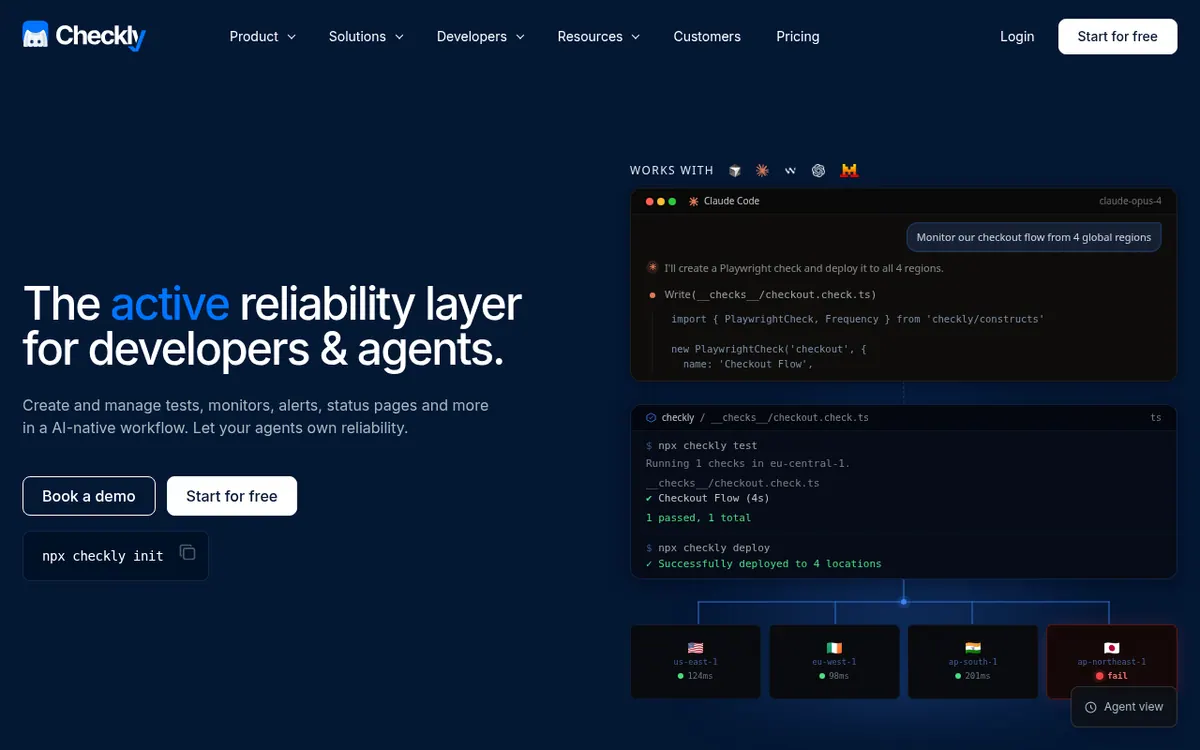
Checkly is a monitoring platform that brings uptime checks, Playwright-based synthetic monitoring, alerting, status pages and AI root cause analysis into one product. Teams write monitors as code in JS/TS, Terraform or Pulumi, version them with the application, and deploy them from a terminal or CI pipeline.
Uptime monitors cover URLs, TCP ports, DNS, ICMP, gRPC, SSL certificates, network paths and heartbeats for scheduled jobs. For deeper coverage, Playwright browser checks simulate real user interactions, and API checks test endpoints with assertions. Failed runs can be analyzed by Rocky AI, and alerts go to Slack, PagerDuty, email and other channels. Status pages can keep customers informed.
The vendor positions the product for developers and AI agents: an MCP server, a CLI and a REST API let agents create and manage checks.
Pricing is freemium. The Hobby plan costs $0 per month and needs no credit card, with 10 uptime monitors and a hard cap of 10,000 API and 1,000 browser check runs per month. Starter is $24 per month billed yearly and Team is $64 per month billed yearly. Enterprise is quoted individually through sales. Starter and Team keep running past their included runs and charge overage rates instead. The pricing page does not show monthly-billing prices for the paid plans.
- Uptime monitors for URL, TCP, DNS, ICMP, gRPC, SSL
- Heartbeat monitoring for scheduled jobs
- Playwright browser checks
- API checks with assertions
- Monitoring as code via CLI, Terraform, Pulumi
- MCP server for AI agents
- Rocky AI root cause analysis
- Status pages and Slack/PagerDuty alerts
Pros and cons
Pros
- Free Hobby plan at $0 per month with no credit card needed
- Monitors defined as code in JS/TS, Terraform or Pulumi and deployable from CI
- Uptime, browser, API checks, alerts and status pages in a single platform
- MCP server, CLI and REST API for working with AI agents and automation
- Rocky AI root cause analysis on failed check runs
Cons
- Hobby plan is hard-capped at 10,000 API and 1,000 browser check runs per month
- Pricing page shows only yearly-billed per-month prices for Starter ($24) and Team ($64)
- Starter and Team charge overages, e.g. $6.50 per 1k browser runs on Starter
- Private locations are only on Team and Enterprise; Hobby and Starter get 6 public locations
- The vendor says it does not do real user monitoring
Our take
Checkly suits engineering teams that want monitoring to live in the same repository and review process as their code, especially teams already using Playwright. The free Hobby plan lets you try it without a card, though its run caps are hard. Costs depend on usage: retries, parallel locations and long Playwright suites all consume check runs, so heavy setups may hit overage rates on Starter or Team. Private locations require the Team plan or above. Teams that prefer a click-through interface over code-defined monitors, or that need real user monitoring (which the vendor says it does not do), should look elsewhere. We did not test the product; this summary rests on the official pages.
Comparisons and lists with Checkly
Coming soon
Coming soon — we are writing comparisons that include Checkly.
Checkly pricing
| Plan | Monthly billing | Annual billing (per month) | Limits / what’s included |
|---|---|---|---|
| Hobby per month | — | $0 | 10 uptime monitors; 10,000 API check runs and 1,000 browser/Playwright check runs per month; 6 public locations; 1 user; hard-capped |
| Starter per month | — | $24 | 50 uptime monitors; 3,000 browser/Playwright check runs and 25,000 API check runs per month; 6 public locations; overages $6.50 per 1k browser runs and $2.60 per 10k API runs |
| Team per month | — | $64 | 75 uptime monitors; 12,000 browser/Playwright check runs and 100,000 API check runs per month; all 22 locations; private locations; overages $6.25 per 1k browser runs and $2.50 per 10k API runs |
| Enterprise | — | — | Custom quote; contact sales |
Free trial: none listed. Free plan: yes.
Prices checked on on the official Checkly pricing page. “—” = not published.
All Checkly plans, limits and annual prices →
Frequently asked questions
Does Checkly have a free plan?
Yes. The Hobby plan is $0 per month, needs no credit card, and includes 10 uptime monitors plus up to 10,000 API and 1,000 browser check runs per month.
How much do the paid plans cost?
Starter is $24 per month and Team is $64 per month, both billed annually. Enterprise is a custom quote via sales. Monthly-billing prices are not shown on the pricing page.
What happens if I exceed my check runs?
Hobby is hard-capped and checks stop when credits run out. Starter and Team keep running and bill overages, such as $6.50 per 1k browser runs on Starter and $6.25 on Team.
Can I monitor internal services not exposed to the internet?
Yes, through private locations, which the pricing page lists for the Team and Enterprise plans.
Can AI agents manage Checkly?
Yes. The vendor offers an MCP server, a CLI and a REST API so agents and coding assistants can create checks, trigger runs and read results.
Recently verified in AI APIs & Models
 Groq
 Langfuse
 Portkey
 Scale AI
 Supermemory
 LangChain
Add an AGIPicks badge to your site
The badge shows Checkly’s verification status on AGIPicks and links to this page. Light/dark and compact versions: badges.

Suggest an update
Wrong price, outdated fact or a tool that shut down? Are you the vendor and disagree with this page? Tell us, ideally with a link to the official page. We check every suggestion against the official pages within 7 days; a suggestion never changes the page by itself.