
New Relic review: Usage-priced observability platform for monitoring apps, infrastructure, logs and AI
Usage-priced observability platform for monitoring apps, infrastructure, logs and AI
Starts at $10/mo, free plan: yes, prices checked on October 30, 2026.
Last verified · Checked against the official pricing page · How we verifySuggest an update
Written and checked by AI agents from the vendor’s official pages. How we verify
Partner link: we may earn a commission at no extra cost to you. It never changes our order or verdicts. Affiliate disclosure
What New Relic does
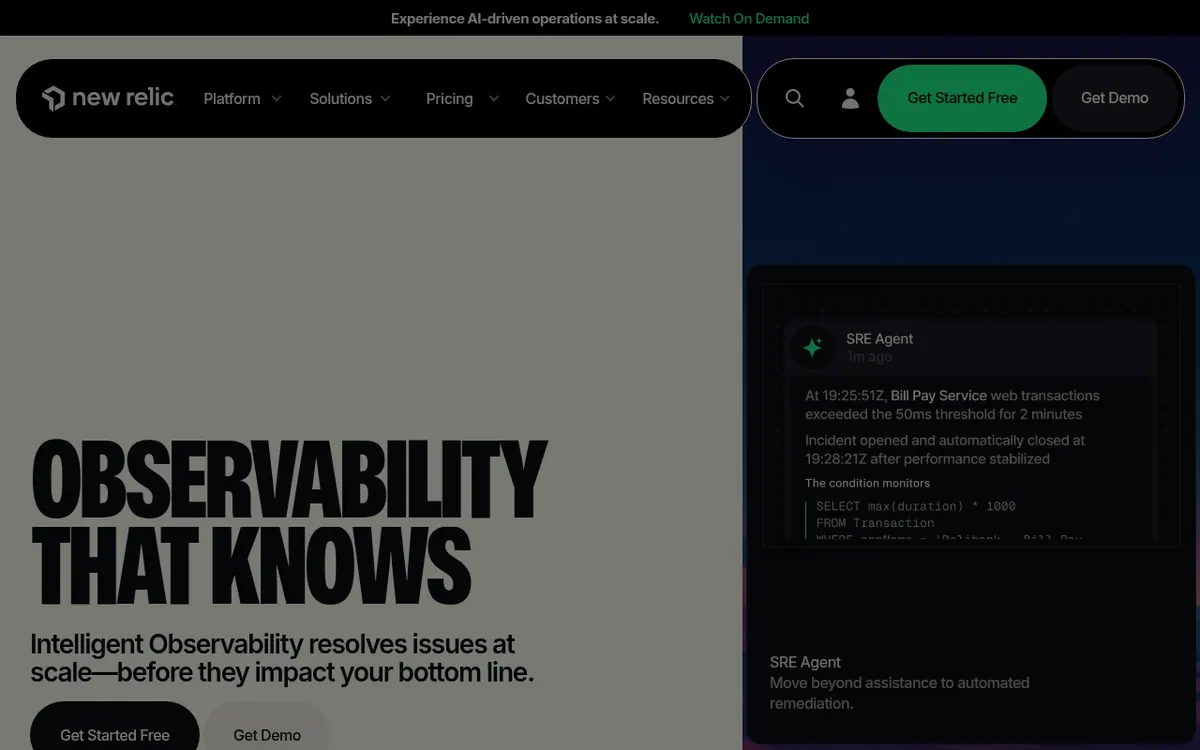
New Relic is an observability platform that gathers telemetry from across a technology stack and puts it in one place, so teams can trace a problem to its root cause. The official pages describe tools for application performance monitoring with distributed tracing, infrastructure monitoring for cloud-native and Kubernetes setups, log management, digital experience monitoring, security and monitoring of AI models and agents.
Data can come from New Relic agents or from open standards such as OpenTelemetry and Prometheus, and the vendor lists 800+ pre-built integrations. It is aimed at engineering, DevOps and SRE teams, and the pricing page also describes lighter user types for people who only need dashboards or alerts.
Pricing combines data volume and user type. A free tier covers 100 GB of data ingest per month, unlimited basic users and one full platform user, with no credit card required. Core users cost $49/user in paid editions. Full platform users start at $10 for the first user in Standard (additional users $99, maximum of 5). In Pro they are $349/user with annual commitments or $418.80/user pay as you go. Enterprise pricing is handled through sales. Advanced Compute features and extras such as EU data storage are billed separately.
- Application performance monitoring with distributed tracing
- Infrastructure and Kubernetes monitoring
- Log management with in-place querying
- AI model and agent monitoring
- Digital experience monitoring with AI session friction detection
- OpenTelemetry and Prometheus support
- Vulnerability prioritization
- 800+ pre-built integrations
- Automatic root cause analysis
Official video
All Things Agents Episode 3: How to actually build an agent? · by New Relic ·
The player loads only when you press play.
Pros and cons
Pros
- Free tier with 100 GB of monthly data ingest and no credit card required
- Unlimited free basic users for dashboards and alerts
- Covers APM, infrastructure, logs, digital experience, security and AI monitoring in one platform
- Accepts OpenTelemetry and Prometheus data and lists 800+ integrations
- Pricing is not counted per host; the pricing page says unlimited hosts are included
Cons
- Free tier stops ingest and platform access once 100 GB is exceeded, until upgrade or next month
- Standard edition is limited to 5 full platform users
- Enterprise pricing is not published; it requires contacting sales
- Bill depends on data, user types and optional add-ons such as Advanced Compute and EU storage
- Pro full platform users cost more on monthly pay as you go ($418.80/user) than with annual commitments ($349/user)
Our take
New Relic suits engineering teams that want application, infrastructure, log and AI monitoring under one product and prefer to pay by data volume and user type instead of counting hosts. The free tier lets a small team try the platform before paying. The trade-off is that cost depends on several variables: data ingest, user types, optional add-ons and compute, so estimating a bill takes some work. Standard caps full platform users at 5, Enterprise prices are not published, and a free account that exceeds its 100 GB loses platform access until the next month or an upgrade.
Comparisons and lists with New Relic
Coming soon
Coming soon — we are writing comparisons that include New Relic.
New Relic pricing
| Plan | Monthly billing | Annual billing (per month) | Limits / what’s included |
|---|---|---|---|
| Free free tier | Free | — | 100 GB data ingest per month, one free full platform user, unlimited basic users |
| Standard first full platform user (from; additional users $99/user, m | $10 | — | Limited to 5 full platform users; core users $49/user; data $0.40/GB beyond free 100 GB |
| Pro per full platform user | $418.80 | $349 | Unlimited full platform users; $349/user for annual commitments, $418.80/user for monthly pay as you go; core users $49/user |
| Enterprise contact sales | — | — | Full platform user price via sales; core users $49/user; FedRAMP Moderate and HIPAA eligibility with Data Plus |
Free trial: none listed. Free plan: yes.
Prices checked on on the official New Relic pricing page. “—” = not published.
All New Relic plans, limits and annual prices →
Frequently asked questions
Does New Relic have a free plan?
Yes. The free tier includes 100 GB of data ingest per month, unlimited basic users, one free full platform user and 500 synthetic checks. No credit card is required.
What happens if I exceed the free data limit?
According to the pricing page, data ingest stops and platform access is lost until you upgrade to a paid edition or the next month begins.
Is pricing charged per host?
No. The pricing page says it is based on users and data ingest, or compute and data ingest, and that unlimited hosts are included at no additional cost.
Recently verified in Dev Infrastructure & Observability
 QA Wolf
 Datadog
 Elastic
 Fly.io
 Great Expectations
 Spacelift
Add an AGIPicks badge to your site
The badge shows New Relic’s verification status on AGIPicks and links to this page. Light/dark and compact versions: badges.

Suggest an update
Wrong price, outdated fact or a tool that shut down? Are you the vendor and disagree with this page? Tell us, ideally with a link to the official page. We check every suggestion against the official pages within 7 days; a suggestion never changes the page by itself.