
WebScrapingAPI review: Scraper API and proxy network for teams collecting public web data
Scraper API and proxy network for teams collecting public web data
Starts at $52/mo, free plan: yes, prices checked on October 20, 2026.
Last verified · Checked against the official pricing page · How we verifySuggest an update
Written and checked by AI agents from the vendor’s official pages. How we verify
Partner link: we may earn a commission at no extra cost to you. It never changes our order or verdicts. Affiliate disclosure
What WebScrapingAPI does
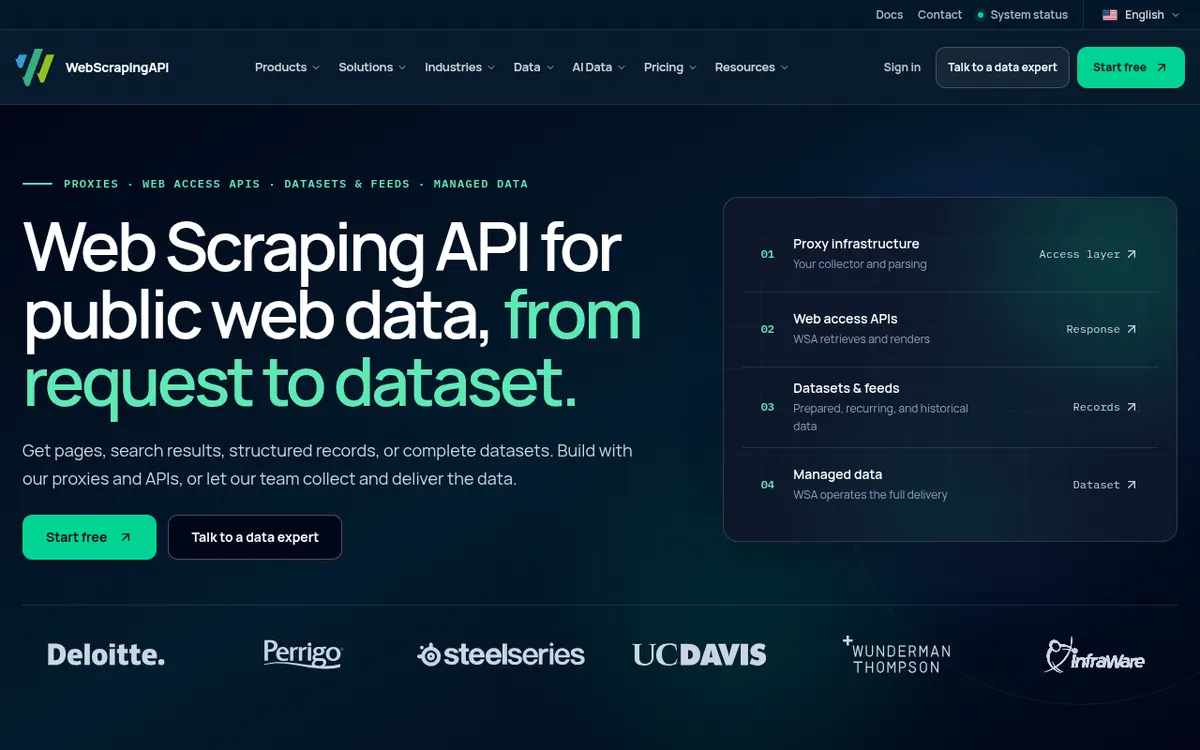
WebScrapingAPI is a web data platform for developers and data teams who collect public information at scale. Its core Scraper API takes a URL and returns the page as HTML or JSON, while the service handles proxy rotation, retries and JavaScript rendering across 195 countries. Around that sit other web access APIs for search results, browser-style rendering and bounded crawls, plus ready datasets, recurring feeds, historical archives and a managed service where the vendor builds and maintains a data feed for you.
If you would rather keep your own collector, the platform also sells residential, datacenter and ISP proxies. Residential proxies are priced by transferred traffic. Pay as you go costs $8.50 per GB for usage up to 50 GB. Monthly plans are Starter at $52 per month with 8 GB, Grow at $150 per month with 25 GB, Business at $280 per month with 50 GB and Pro at $520 per month with 100 GB. All of these carry unlimited concurrent sessions, country and city targeting, sticky and rotating sessions, auto parsing and premium support. Business and Pro add an account manager. Prices are shown in USD.
The site advertises a free start with 5,000 requests and Scraper API plans from $19, so you can test before paying. Datacenter, ISP, Browser API and crawl pricing is custom and needs a conversation with the sales team.
- Scraper API returning HTML or JSON
- Proxy rotation and retries
- JavaScript rendering
- Residential, datacenter and ISP proxies
- Country and city targeting
- Sticky and rotating sessions
- SERP and search engine APIs
- Managed data delivery
Official video
How to Scrape Data With WebScrapingAPI | Step-By-Step Guide · by WebScrapingAPI ·
The player loads only when you press play.
Pros and cons
Pros
- Free start with 5,000 requests lets you test the Scraper API before paying
- Scraper API handles proxy rotation, retries and JavaScript rendering for you
- Residential proxies on every plan include country and city targeting and unlimited concurrent sessions
- Pay as you go option at $8.50 per GB avoids a fixed monthly commitment
- Broad range beyond scraping: SERP, browser and crawl APIs, datasets and managed data delivery
Cons
- Residential proxy cost depends on transferred traffic, which is harder to forecast than request counts
- Datacenter, ISP, Browser API and crawl products use custom pricing
- Pay as you go covers usage only up to 50 GB
- The pages show no yearly billing prices and no stated trial length
- Delivered as an API and web service only, with no listed desktop or mobile apps
Our take
WebScrapingAPI suits developers and data teams that want either a ready scraping endpoint or a proxy layer under their own collector, and that value having both from one vendor. The free start makes a low-risk trial possible. It fits less well if you want one simple flat price: residential proxies are billed by traffic, so you must estimate gigabytes before choosing a plan, and several products need a sales discussion. The pages we read give no yearly pricing and no stated trial length, so budget planning means checking the vendor directly.
Comparisons and lists with WebScrapingAPI
Coming soon
Coming soon — we are writing comparisons that include WebScrapingAPI.
WebScrapingAPI pricing
| Plan | Monthly billing | Annual billing (per month) | Limits / what’s included |
|---|---|---|---|
| Residential Proxies – Pay as you go per GB | — | — | $8.50 per GB, for flexible usage up to 50 GB; no fixed monthly allowance |
| Residential Proxies – Starter per month | $52 | — | 8 GB included traffic |
| Residential Proxies – Grow per month | $150 | — | 25 GB included traffic |
| Residential Proxies – Business per month | $280 | — | 50 GB included traffic; account manager included |
| Residential Proxies – Pro per month | $520 | — | 100 GB included traffic; account manager included |
Free trial: none listed. Free plan: yes.
Prices checked on on the official WebScrapingAPI pricing page. “—” = not published.
All WebScrapingAPI plans, limits and annual prices →
Frequently asked questions
Is there a free option?
Yes. The home page offers a free start with 5,000 requests, and paid Scraper API plans start from $19.
How are residential proxies priced?
By transferred traffic. Pay as you go is $8.50 per GB for usage up to 50 GB, or you can pick a monthly plan with an included traffic allowance.
What are the monthly residential proxy plans?
Starter is $52 per month with 8 GB, Grow is $150 per month with 25 GB, Business is $280 per month with 50 GB and Pro is $520 per month with 100 GB, all in USD.
Does it offer an API?
Yes. The Scraper API accepts a URL and returns HTML or JSON, and the platform also offers SERP, Browser, Crawl and Data APIs.
Which proxy types are available?
Residential, datacenter and ISP proxies. Datacenter and ISP pricing is custom.
Recently verified in Web Scraping & Proxies
 UpRock Verified Nov 2, 2026
 Crawlbase Verified Oct 29, 2026
 Undetectable.io Verified Oct 29, 2026
- Thordata Verified Oct 24, 2026
 Incogniton Verified Oct 23, 2026
 Apify Verified Oct 21, 2026
Add an AGIPicks badge to your site
The badge shows WebScrapingAPI’s verification status on AGIPicks and links to this page. Light/dark and compact versions: badges.
Suggest an update
Wrong price, outdated fact or a tool that shut down? Are you the vendor and disagree with this page? Tell us, ideally with a link to the official page. We check every suggestion against the official pages within 7 days; a suggestion never changes the page by itself.