
Glass Health review: Clinical AI API with cited answers and audio scribing for healthcare products
Clinical AI API with cited answers and audio scribing for healthcare products
Starts at $250/mo, free plan: no, prices checked on October 29, 2026.
Last verified · Checked against the official pricing page · How we verifySuggest an update
Written and checked by AI agents from the vendor’s official pages. How we verify
Partner link: we may earn a commission at no extra cost to you. It never changes our order or verdicts. Affiliate disclosure
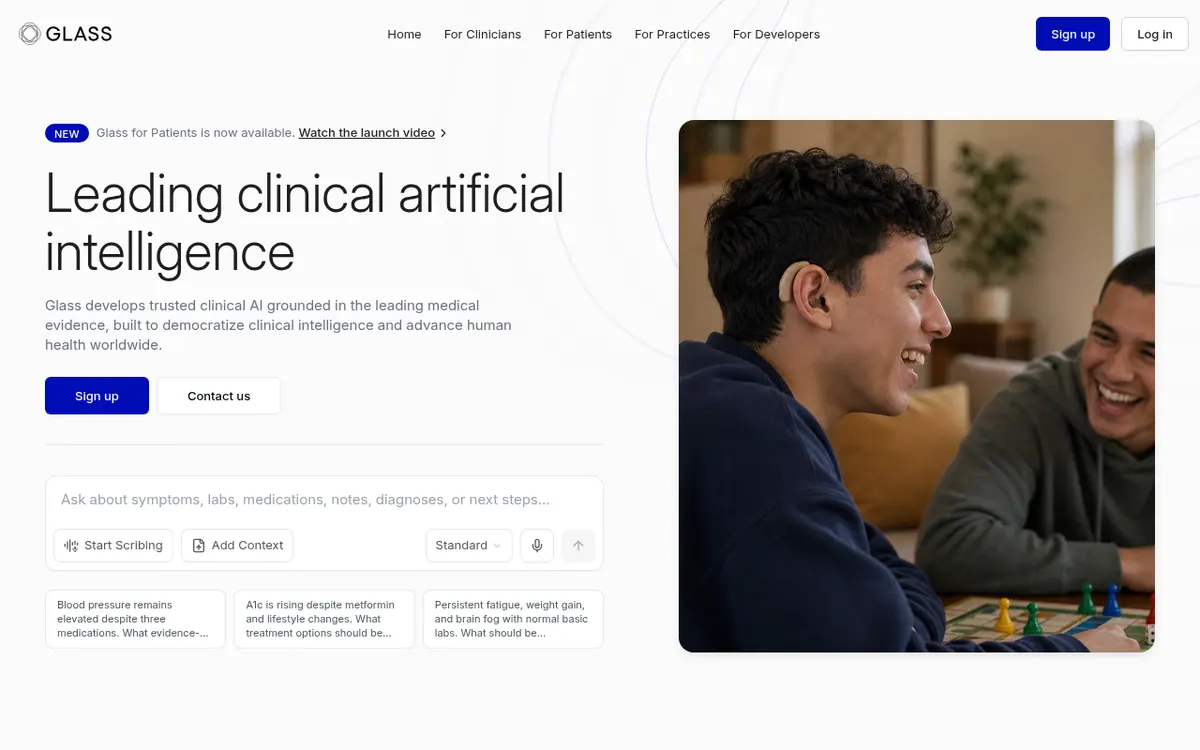
What Glass Health does
Provides an API that returns cited clinical answers and turns encounter audio into transcripts and structured notes for use inside other products.
Glass Health offers a clinical intelligence API that lets a software team add medical question answering and documentation to its own product. A request to the Messages endpoint returns a written answer together with numbered references, so end users can check the sources behind it. The vendor lists use cases such as diagnostic support, treatment planning, triage, scribing, and billing and coding.
A separate scribing endpoint takes encounter audio and returns a speaker-separated transcript plus a structured note. Developers can pass their own note prompt, and the page mentions 50+ languages and eight audio formats. Responses can be streamed.
The vendor says answers draw on 38M+ peer-reviewed citations, current guidelines and 150,000+ FDA drug labels. It describes HIPAA-compliant infrastructure and BAAs, and production use with protected health information requires accepting a click-through BAA.
Pricing is published. The Glass Developer API starts at $250 per month, with usage counted against that minimum. Beyond it, overage is billed per token: Glass 5.5 costs $3 / $16 per 1M input / output tokens, and Glass 5.0 costs $10 / $50. Scribing transcription is $0.85 per hour of audio, and note generation uses the same token rates. Rate limits apply per organization, and higher limits are available by contacting the vendor.
- Evidence-grounded answers with inline citations
- Diagnostic and treatment support
- Triage support
- Audio scribing with diarized transcripts
- Custom note prompts
- 50+ transcription languages
- Streaming responses
- HIPAA-compliant infrastructure with BAAs
Official video
Glass Health Product Demo · by Glass Health ·
The player loads only when you press play.
Good for / Not for
Good for
- Telehealth or health apps that want cited clinical Q&A or triage in their own interface
- Teams building an ambient scribing product that needs transcript and note generation
- Developers who want published usage-based pricing before contacting sales
Not for
- Anyone needing a free plan or trial, since none is stated for the API
- Low-volume experiments that cannot commit to a $250 monthly minimum
How to start
Sign up for a developer account on the self-serve page; no sales call is needed. source
Your key is displayed only a single time after provisioning, so copy it and include it in the X-Api-Key header with each request. source
Send a POST with messages to the Messages endpoint; set stream to true for streaming. source
Start by testing with synthetic or de-identified data, and agree to the click-through BAA before any production PHI is used. source
Limits and gotchas
- Each organization is limited, per 60-second window, to 100 requests, 200,000 input tokens and 40,000 output tokens. source
- Usage beyond the $250 monthly minimum is billed as overage at per-token rates. source
- Besides the token costs for generating notes, scribing transcription is charged at $0.85 for every hour of audio. source
From the official site and docs of Glass Health, checked on October 29, 2026.
Pros and cons
Pros
- Prices are printed openly, including per-token rates for Glass 5.5 and Glass 5.0
- Answers come with numbered references that end users can inspect
- One scribing call returns a speaker-separated transcript and a structured note
- Supports 50+ languages and eight audio formats for transcription
- HIPAA-compliant infrastructure with BAAs available
Cons
- No free plan or free trial is stated for the API
- Starts at a $250 monthly minimum, which may be a lot for small experiments
- Default rate limits are 100 requests per 60 seconds per organization; higher limits require contacting the vendor
- Production use with PHI requires accepting a click-through BAA first
- Pricing for the clinician, patient and practice products is not shown on the provided page
Our take
This API suits product teams building telehealth, symptom-checking, scribing or decision-support features who want cited clinical answers without training their own model. Published usage-based pricing makes it possible to plan costs before talking to sales. It is less suitable for anyone who wants a free tier or a trial, since the pages state neither, or for those who just need a ready-made app for personal use rather than an integration. The $250 monthly minimum is a fixed commitment even at low volume, and the stated rate limits may need a conversation with the vendor at scale. We have not tested the output; the evidence claims come from the vendor's own pages.
Comparisons and lists with Glass Health
Coming soon
Coming soon — we are writing comparisons that include Glass Health.
Glass Health pricing
| Plan | Monthly billing | Annual billing (per month) | Limits / what’s included |
|---|---|---|---|
| Glass Developer API per month minimum, usage counted against it, then per-token | $250 | — | Monthly minimum of $250; Glass 5.5 $3 / $16 per 1M input / output tokens; Glass 5.0 $10 / $50 per 1M; rate limits per organization per 60-second window: 100 requests, 200,000 input tokens, 40,000 output tokens |
Free trial: none listed. Free plan: no.
Prices checked on on the official Glass Health pricing page. “—” = not published.
Frequently asked questions
How much does the Glass Developer API cost?
It starts at $250 per month with usage counted against that minimum. Beyond it, usage is billed per token: Glass 5.5 is $3 / $16 per 1M input / output tokens and Glass 5.0 is $10 / $50.
Is there a free plan or trial?
The official pages provided do not state a free plan or a free trial for the API.
How is scribing billed?
Transcription is $0.85 per hour of audio, and note generation uses the same token rates as the Messages API.
What are the rate limits?
Per organization in each 60-second window: 100 requests, 200,000 input tokens and 40,000 output tokens. Higher limits are available via contact@glass.health.
Can I use it with real patient data?
You can test with synthetic or de-identified data first. Before production PHI, you must accept the click-through BAA in the settings page.
Recently verified in AI Customer Support
 Intercom Fin
 Upfirst
 Zendesk
 Botpress
Add an AGIPicks badge to your site
The badge shows Glass Health’s verification status on AGIPicks and links to this page. Light/dark and compact versions: badges.
Suggest an update
Wrong price, outdated fact or a tool that shut down? Are you the vendor and disagree with this page? Tell us, ideally with a link to the official page. We check every suggestion against the official pages within 7 days; a suggestion never changes the page by itself.