
Hoppscotch review: Open source API development tool for building, testing and debugging requests
Open source API development tool for building, testing and debugging requests
Not published, free plan: no, prices checked on October 30, 2026.
Last verified · Checked against the official website · How we verifySuggest an update
Written and checked by AI agents from the vendor’s official pages. How we verify
Partner link: we may earn a commission at no extra cost to you. It never changes our order or verdicts. Affiliate disclosure
What Hoppscotch does
Lets you build REST API requests, add scripts and authorization, run tests on responses and organize them in collections.
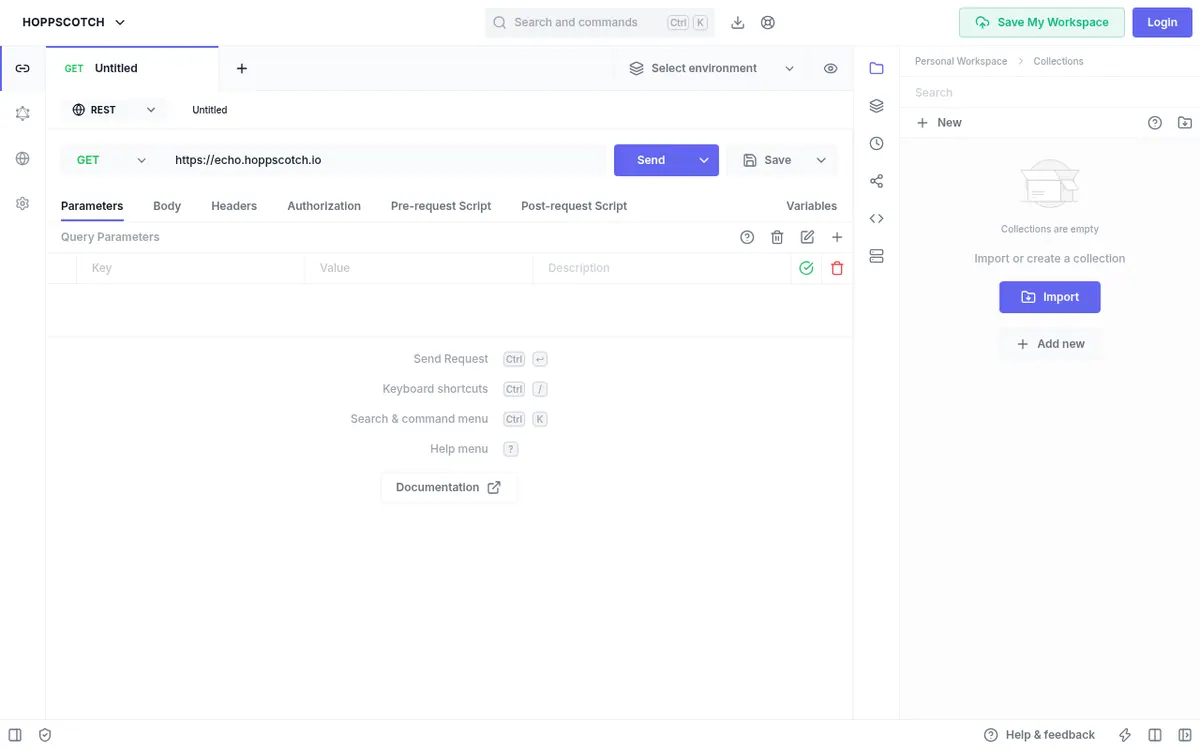
Hoppscotch describes itself as an open source API development ecosystem. Its REST section lets you define an endpoint, pick an HTTP method such as GET, POST or PUT, and add headers, parameters, a request body and authorization. You can also write JavaScript scripts that run before a request is sent or after the response arrives, and run tests against the responses you get back. Responses can be downloaded or copied for further use.
To keep work organized, the tool includes collections, environments and history. Authorization can be configured with Basic Auth, Bearer tokens, API keys, OAuth 2.0, Digest, AWS Signature and JWT, and it can be set once on a collection or subfolder so that nested requests inherit it. The documentation mentions both Hoppscotch Cloud and self-hosted editions, plus a Desktop application and an Agent interceptor.
The pages provided do not include a pricing page, so Pricing not published on the official site in the material we reviewed. We cannot state whether there is a free plan, a trial, paid tiers or any limits on usage. The homepage shows a Login option and a Save My Workspace button, which suggests an account is used to keep workspaces. Stated limits in the docs are narrow: OAuth 2.0 flows are not fully supported in the Desktop application yet, Digest Auth needs the Agent interceptor, and expired bearer tokens must be refreshed by hand.
- REST requests with HTTP methods, headers, parameters and body
- JavaScript pre-request and post-request scripts
- Tests on API responses
- Collections, environments and history
- Many authorization types
- Collection-level inherited authorization
- Download and copy responses
Good for / Not for
Good for
- Developers testing and debugging REST API endpoints
- Teams that want to set authorization once on a collection and reuse it
- Users who want an open source tool with self-hosted editions
Not for
- Buyers who need published pricing before deciding
- Desktop users who depend on full OAuth 2.0 workflows, which are still in progress
How to start
Limits and gotchas
From the official site and docs of Hoppscotch, checked on October 30, 2026.
Pros and cons
Pros
- Described as an open source API development ecosystem
- Supports many authorization types, including Basic Auth, Bearer tokens, OAuth 2.0, JWT and AWS Signature
- Authorization can be set at collection level and inherited by requests
- Pre-request and post-request scripts in JavaScript, plus response tests
- Self-hosted editions are mentioned alongside Hoppscotch Cloud
Cons
- Pricing not published on the official site pages we reviewed
- OAuth 2.0 workflows are not fully supported in the Desktop application yet
- Digest Auth works only with the Hoppscotch Agent interceptor
- Expired bearer tokens have to be refreshed manually
Our take
Hoppscotch fits developers who want a request-builder for REST APIs with scripting, tests, collections and a wide set of authorization types, and who value that the product describes itself as open source and offers self-hosted editions. It is less clear for buyers who need firm pricing information, because no pricing page was available and we cannot say what any plan costs or includes. The documentation also notes that OAuth 2.0 is still a work in progress in the Desktop app, so teams relying on that combination should check first. We have not used the product; this view comes only from the official pages.
Comparisons and lists with Hoppscotch
Coming soon
Coming soon — we are writing comparisons that include Hoppscotch.
Hoppscotch pricing
Pricing not published on the official site. Check Hoppscotch’s website.
Free trial: none listed. Free plan: no.
Prices checked on on the official Hoppscotch pricing page. “—” = not published.
Frequently asked questions
Is Hoppscotch open source?
Its homepage title calls it an open source API development ecosystem.
How much does Hoppscotch cost?
Pricing not published on the official site pages we reviewed, so no plan, free tier or trial can be stated.
Which authorization methods does it support?
The documentation lists Basic Auth, Bearer tokens, API keys, OAuth 2.0, Digest, AWS Signature and JWT.
Can I self-host it?
The authorization documentation refers to self-hosted editions in addition to Hoppscotch Cloud.
Recently verified in AI APIs & Models
 Langfuse Verified Nov 2, 2026
 Portkey Verified Nov 2, 2026
 Supermemory Verified Nov 2, 2026
 LangChain Verified Oct 31, 2026
 Hugging Face Verified Oct 30, 2026
 Postman Verified Oct 30, 2026
Add an AGIPicks badge to your site
The badge shows Hoppscotch’s verification status on AGIPicks and links to this page. Light/dark and compact versions: badges.

Suggest an update
Wrong price, outdated fact or a tool that shut down? Are you the vendor and disagree with this page? Tell us, ideally with a link to the official page. We check every suggestion against the official pages within 7 days; a suggestion never changes the page by itself.