
Modal review: Serverless GPU and CPU cloud for running AI inference, training and agent sandboxes
Serverless GPU and CPU cloud for running AI inference, training and agent sandboxes
Starts at $250/mo, free plan: yes, prices checked on October 30, 2026.
Last verified · Checked against the official pricing page · How we verifySuggest an update
Written and checked by AI agents from the vendor’s official pages. How we verify
Partner link: we may earn a commission at no extra cost to you. It never changes our order or verdicts. Affiliate disclosure
What Modal does
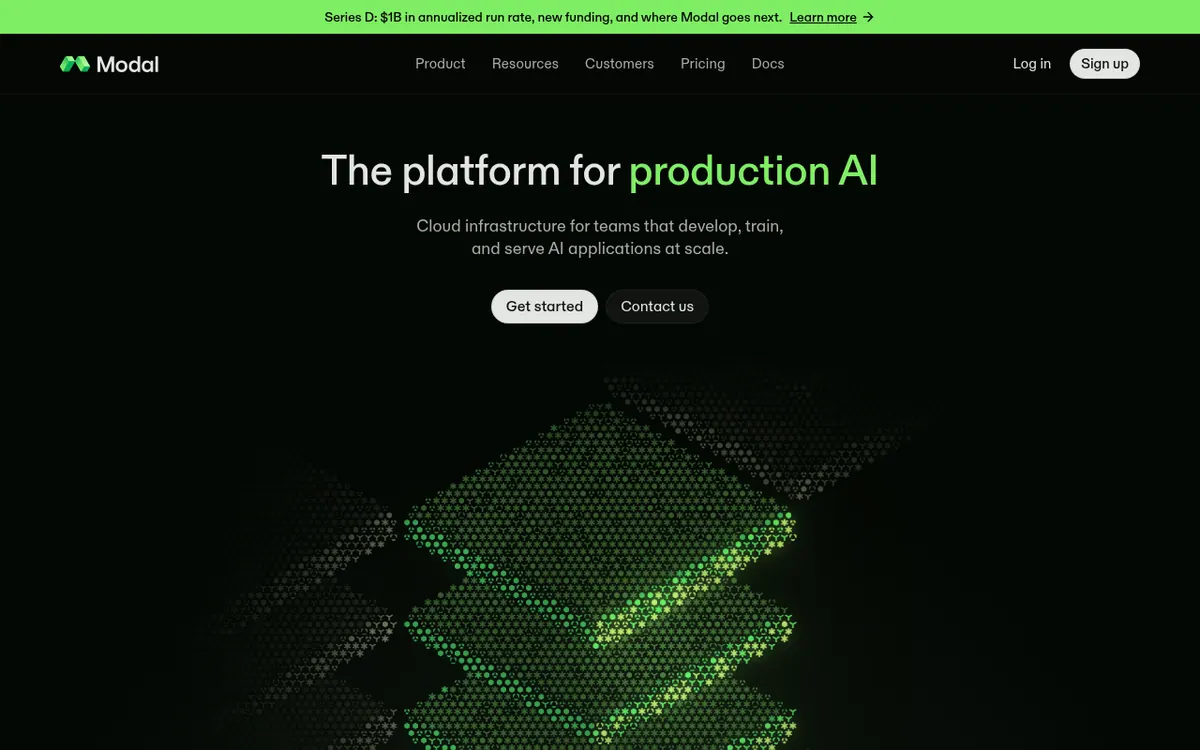
Runs AI workloads on serverless GPUs and CPUs: serving models, fine-tuning them, and hosting isolated sandboxes for agent code.
Modal is a cloud infrastructure platform for teams that build, train and serve AI applications. Its main products are Inference, for serving language, image, video and audio models; Sandboxes, which are isolated environments for coding agents, reinforcement learning rollouts and untrusted code; and Training, for fine-tuning and RL on GPUs. Functions let developers turn code into scalable compute, including HTTPS endpoints that scale to zero when idle.
Pricing is usage-based. Compute is billed by the second for GPUs, CPU cores and memory, and the pricing page says nothing is charged for idle time. There are three plans. Starter costs $0 plus compute per month and includes $30 per month in free credits, 3 workspace seats, 100 containers and 10 GPU concurrency. Team costs $250 plus compute per month and includes $100 per month in credits, unlimited seats, 5000 containers and 50 GPU concurrency. Enterprise pricing is custom and adds audit logs, Okta SSO, HIPAA and support through a private Slack.
Some costs sit outside the plan allowance. Shared Endpoints are billed per token rather than per second, and included compute does not cover them. Non-preemptible execution is priced at 3x base prices, and Sandboxes are billed at that rate. Region selection carries a multiplier on base prices. Observability covers logs and metrics, and data can be exported to OpenTelemetry providers. The site states that applications must be containerized and use Python.
- Inference for LLM, image, video and audio models
- Isolated Sandboxes for agents and untrusted code
- Fine-tuning and reinforcement learning on GPUs
- Functions that scale to zero when idle
- OpenAI-compatible endpoints
- Logs and metrics with OpenTelemetry export
- Per-second GPU and CPU billing
Official video
Runtime 2026 Product Launch Keynote | Erik Bernhardsson, CEO @ Modal · by Modal ·
The player loads only when you press play.
Good for / Not for
Good for
- Teams serving models with spiky or unpredictable traffic
- Developers running agent or reinforcement learning rollouts in isolated sandboxes
- Teams fine-tuning models on GPUs without managing clusters
Not for
- Teams needing audit logs, SSO or HIPAA compatibility without an Enterprise plan
- Workloads that cannot be containerized or do not use Python
How to start
Limits and gotchas
- Starter allows up to 3 seats, 100 containers and 10 GPU concurrency. source
- Shared Endpoints are billed per token from the first request and are not covered by included compute. source
- Non-preemptible execution is billed at 3x base prices, and Sandboxes are billed at that rate. source
- Containers stay alive 60 seconds after the last input by default, and that time is billed. source
From the official site and docs of Modal, checked on October 30, 2026.
Pros and cons
Pros
- Billed by the second, with nothing charged for idle time
- Starter plan has no monthly fee and includes $30 per month in compute
- Covers inference, sandboxes and training in one platform
- Team plan offers unlimited seats, 5000 containers and 50 GPU concurrency
- SOC 2 Type II compliance listed on all plans
Cons
- Starter is limited to 3 seats, 100 containers and 10 GPU concurrency
- Shared Endpoints are billed per token and not covered by included compute
- Non-preemptible execution and Sandboxes cost 3x base prices
- Audit logs, SSO and HIPAA compatibility are Enterprise-only
- Enterprise pricing is custom and not published
Our take
Modal fits engineering teams that want to run GPU-heavy AI workloads, such as model serving, fine-tuning or large numbers of agent sandboxes, without managing servers. Billing by the second with no idle charge suits spiky or unpredictable traffic, and the free $30 monthly credit on Starter allows a low-cost start. The trade-offs are visible on the pricing page: Starter is capped at 3 seats and 100 containers, token billing for Shared Endpoints sits outside the credit, and sandboxes and region selection cost more than base rates. The pages describe deployment as Python-based and containerized, so teams working in other setups should check fit first. Enterprise price is not published.
Comparisons and lists with Modal
Coming soon
Coming soon — we are writing comparisons that include Modal.
Modal pricing
| Plan | Monthly billing | Annual billing (per month) | Limits / what’s included |
|---|---|---|---|
| Starter per month + compute | Free | — | $30 / month free credits; 3 workspace seats included; 100 containers + 10 GPU concurrency; 1 TiB / month free network egress |
| Team per month + compute | $250 | — | $100 / month free credits; unlimited seats; 5000 containers + 50 GPU concurrency; 10 TiB / month free network egress |
| Enterprise | — | — | Custom pricing; volume-based discounts; unlimited seats; 100 TiB / month free network egress |
Free trial: none listed. Free plan: yes.
Prices checked on on the official Modal pricing page. “—” = not published.
All Modal plans, limits and annual prices →
Frequently asked questions
Does Modal have a free plan?
Yes. The Starter plan has no monthly fee and includes $30 of compute per month. Usage beyond that, or items the credit does not cover, is billed.
How much does the Team plan cost?
The Team plan costs $250 plus compute per month. It includes $100 per month in credits and unlimited seats. No annual price is shown.
How is compute billed?
GPUs, CPUs and memory are billed by the second, with nothing charged for idle time. By default containers stay alive for 60 seconds after the last input, and that period is billed.
Are Shared Endpoints covered by the included credit?
No. Shared Endpoints are billed per token, not per second, and the included usage does not apply to them.
How many users can the Starter plan have?
Starter allows up to three users in a workspace. The Team plan unlocks unlimited seats.
Recently verified in AI Marketing
 AEO Engine Verified Nov 2, 2026
 Crush Partners Verified Nov 2, 2026
 Metabase Verified Nov 2, 2026
 Monte Carlo Verified Nov 2, 2026
 Rainbrand (Bloom) Verified Nov 2, 2026
 Rill Data Verified Nov 2, 2026
Add an AGIPicks badge to your site
The badge shows Modal’s verification status on AGIPicks and links to this page. Light/dark and compact versions: badges.
Suggest an update
Wrong price, outdated fact or a tool that shut down? Are you the vendor and disagree with this page? Tell us, ideally with a link to the official page. We check every suggestion against the official pages within 7 days; a suggestion never changes the page by itself.