
Splunk review: Data platform for security and observability, sold by quote with free trials
Data platform for security and observability, sold by quote with free trials
Custom (contact sales), free plan: no, free trial: 14-day free trial for Splunk Cloud Platform (no credit card required), prices checked on October 30, 2026.
Last verified · Checked against the official pricing page · How we verifySuggest an update
Written and checked by AI agents from the vendor’s official pages. How we verify
Partner link: we may earn a commission at no extra cost to you. It never changes our order or verdicts. Affiliate disclosure
What Splunk does
Searches and analyzes machine data for security and observability, with products for SIEM, infrastructure monitoring, application performance, on-call and AI agents.
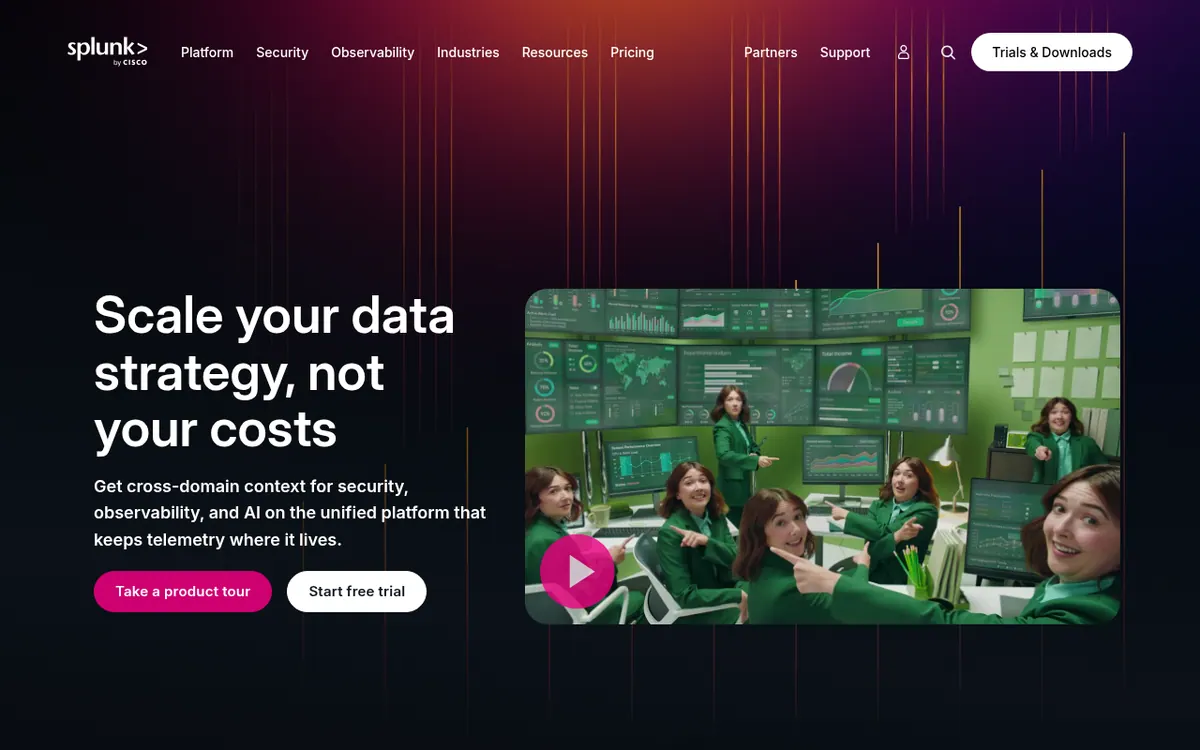
Splunk is a data platform that brings security, observability and AI-related monitoring together, so teams can search and analyze machine data without always moving it. The vendor says it works at petabyte scale and lets data stay where it already lives.
The catalog entry covers several products. Splunk Cloud Platform is the Splunk-managed SaaS version, and Splunk Enterprise can be deployed in a private cloud or on-prem, including air-gapped setups. Splunk Enterprise Security bundles SIEM, SOAR, UEBA and threat intelligence, with Essentials and Premier editions. Splunk Observability Cloud correlates metrics, traces and logs, while Splunk AppDynamics, IT Service Intelligence and On-Call address application performance, service health and incident response. Splunk Agent Observability is aimed at evaluating AI agents and tracking token spend.
On the data side, Ingest and Edge Processors filter, redact and route data before indexing, and Federated Search queries data in place. The Splunk AI Assistant app helps people write SPL queries in natural language. The vendor lists 2000+ integrations through Splunkbase.
Pricing is mostly quote-based. The platform offers activity-based, workload or ingest pricing, and Splunk also mentions entity pricing. A few products show starting prices, all billed annually: Observability Cloud from $15 per host per month, AppDynamics from $6 per CPU core per month, On-Call from $5 per user per month for up to 10 seats, and Agent Observability from $100 per month per 1.2 million spans. Cloud Platform has a 14-day trial and Enterprise a 60-day trial, both without a credit card.
- Petabyte-scale data platform for security and observability
- Federated Search across data where it is stored
- Ingest and Edge Processors for filtering and routing
- SIEM, SOAR and UEBA in Enterprise Security
- Metrics, traces and logs correlation in Observability Cloud
- AI agent evaluation and token cost tracking
- SPL queries from natural language via AI Assistant
- On-call scheduling and escalation policies
Official video
Splunk Observability Cloud and Ansible Automation Platform - How to Remediate Alerts with Ansible · by Splunk ·
The player loads only when you press play.
Good for / Not for
Good for
- Security teams wanting SIEM, SOAR and UEBA in one product
- Organizations needing on-prem or air-gapped deployment
- Teams wanting to search data where it already lives to cut data movement
- Operations teams that need on-call scheduling and escalation
Not for
- Buyers who want a fixed, self-serve price for the core platform (quote-based)
- Those needing monthly-billed published prices (starting prices shown are billed annually)
How to start
Limits and gotchas
- On-Call's starting price of $5 per user per month applies to up to 10 seats. source
- Licensing may set capacity thresholds such as data ingestion volume or seat counts, depending on the product. source
- Overages are charged only when you consistently exceed purchased ingestion or storage capacity. source
From the official site and docs of Splunk, checked on October 30, 2026.
Pros and cons
Pros
- Covers security, observability and AI-agent monitoring under one vendor
- Cloud, private cloud, on-prem and air-gapped deployment options
- Trials of 14 days (Cloud Platform) and 60 days (Enterprise), no credit card
- Federated Search and Edge Processors aim to reduce data movement and ingest costs
- Several products publish starting prices, such as $15 per host per month for Observability Cloud
Cons
- Core platform and Enterprise Security pricing is only available via 'Get a quote'
- Several pricing models (activity, ingest, workload, entity) make costs harder to compare
- Published starting prices are all billed annually, with no monthly-billing price shown
- No clear free plan stated; only trials and a 'Free edition' label on some products
- Platform, mobile and API support are not stated on the official pages
Our take
Splunk fits organizations that need one vendor for security operations, infrastructure monitoring and data management, and that are comfortable talking to sales. It suits teams with large telemetry volumes who want to search data in place and choose between cloud and on-prem deployment. It is a weaker fit for individuals or small teams wanting a clear self-serve price: the core platform, Enterprise and Enterprise Security are quote-based, and the published starting prices cover only a few products. The range of products and pricing models (activity, ingest, workload, entity) means you should expect to scope your needs before comparing costs. The free trials are a sensible first step.
Comparisons and lists with Splunk
Coming soon
Coming soon — we are writing comparisons that include Splunk.
Splunk pricing
| Plan | Monthly billing | Annual billing (per month) | Limits / what’s included |
|---|---|---|---|
| Splunk Observability Cloud (Infrastructure) per host per month, starting at, billed annually | — | $15 | Starting price; the page lists it as billed annually per host/month. |
| Splunk Agent Observability per month per 1.2 million spans, starting at, billed annuall | — | $100 | Includes 500 million Luna tokens and 5 Luna fine-tuning runs per year. |
| Splunk AppDynamics per month, per CPU core, starting at, billed annually | — | $6 | Starting price only. |
| Splunk On-Call per user per month, starting at, billed annually | — | $5 | For up to 10 seats. |
Free trial: 14-day free trial for Splunk Cloud Platform (no credit card required). Free plan: no.
Prices checked on on the official Splunk pricing page. “—” = not published.
All Splunk plans, limits and annual prices →
Frequently asked questions
Does Splunk have a free trial?
Yes. Splunk Cloud Platform offers a 14-day trial and Splunk Enterprise a 60-day trial, both with no credit card required.
How much does Splunk cost?
Most plans are quote-based. Published starting prices, billed annually, include $15 per host per month for Observability Cloud, $6 per CPU core per month for AppDynamics and $5 per user per month for On-Call (up to 10 seats).
Can I deploy Splunk on-premises?
Yes. Splunk Enterprise can be deployed in a private cloud or on-prem, including air-gapped environments. Splunk Cloud Platform is the Splunk-managed SaaS version.
Are there limits on users?
The pricing page says there are no explicit limits on usage or the number of users at one organization, though licensing may set capacity such as ingestion volume or seat counts depending on the product.
Recently verified in AI Marketing
 Banoffee Verified Nov 3, 2026
 AEO Engine Verified Nov 2, 2026
 Crush Partners Verified Nov 2, 2026
 Metabase Verified Nov 2, 2026
 Monte Carlo Verified Nov 2, 2026
 Rainbrand (Bloom) Verified Nov 2, 2026
Add an AGIPicks badge to your site
The badge shows Splunk’s verification status on AGIPicks and links to this page. Light/dark and compact versions: badges.

Suggest an update
Wrong price, outdated fact or a tool that shut down? Are you the vendor and disagree with this page? Tell us, ideally with a link to the official page. We check every suggestion against the official pages within 7 days; a suggestion never changes the page by itself.