
Context.dev review: Web data API for AI agents: scrape, search, crawl and monitor pages
Web data API for AI agents: scrape, search, crawl and monitor pages
Starts at $20/mo, free plan: yes, prices checked on October 29, 2026.
Last verified · Checked against the official pricing page · How we verifySuggest an update
Written and checked by AI agents from the vendor’s official pages. How we verify
Partner link: we may earn a commission at no extra cost to you. It never changes our order or verdicts. Affiliate disclosure
What Context.dev does
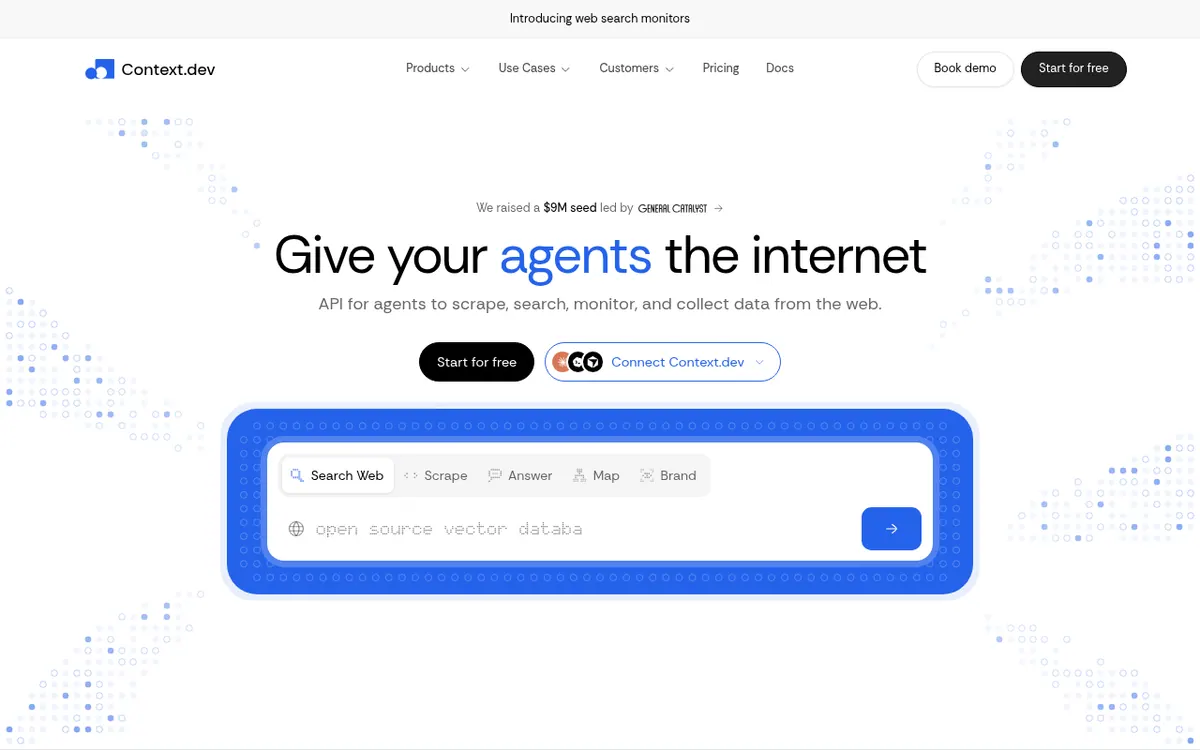
Context.dev is a web data API built for AI agents and the products around them. One REST API covers scraping a URL into Markdown, HTML, structured fields, images or screenshots, searching the web or news, crawling and mapping whole sites, and running batch jobs over many URLs. It also offers research-style answers that return structured JSON with source URLs, monitors that watch pages on a schedule and call a webhook, and brand data such as company profiles and design systems pulled from a domain.
The vendor says JavaScript rendering, anti-bot bypass and proxies are included in the base scrape price, so there is no separate proxy fee. Official SDKs exist for TypeScript, Python, Ruby, Go and PHP, and the integrations page lists MCP connections for AI tools.
Pricing is credit based. The Free Tier costs $0 per month and includes 1,000 credits with no overage. Developer is $20 per month with 10,000 credits, and Pro is $90 per month with credit tiers up to 2.5M. The pricing FAQ also names Growth at $300, Scale at $500 and Scale 2.5M at $950 per month, plus a custom Enterprise plan. Different endpoints cost different numbers of credits; a standard scrape starts at 1 credit. Annual billing saves two months, though the page does not state a per-month yearly price. Eligible startups and nonprofits can apply for a discount.
- Scrape pages to Markdown, HTML or screenshots
- Web and news search
- Site crawl and URL mapping
- Batch jobs for thousands of URLs
- Structured research answers with sources
- Scheduled page monitors with webhooks
- Brand data and styleguide extraction
- SDKs and MCP support
Pros and cons
Pros
- Free plan with 1,000 credits per month and no credit card required
- JS rendering, anti-bot bypass and proxies are included in the base scrape price
- One API covers scrape, search, crawl, batches, monitors and brand data
- Official SDKs for TypeScript, Python, Ruby, Go and PHP
- Failed requests are mostly not billed, according to the vendor
Cons
- No one-time lookups; the vendor points to a subscription or contacting them
- Free plan has no overage and allows only 2 concurrent requests
- Credit costs vary by endpoint, such as 5 credits per page for JSON extraction
- Annual per-month prices are not stated, only that annual billing saves two months
- Scrape waits up to 90 seconds by default, so slow pages may need timeout settings
Our take
Context.dev fits developers and teams building AI agents, RAG pipelines or enrichment features who want scraping, search, crawling and monitoring behind one credit balance, with rendering and proxies not billed separately. The free plan allows real testing before paying. It fits less well if you need one-time lookups, which the vendor says it does not support, or if you want predictable flat pricing, since cost depends on which endpoints you call and how many credits each uses. The pricing page shows one price per plan, so check the annual per-month rate in the toggle before budgeting. We have not tested the product; this summary comes from the official pages only.
Comparisons and lists with Context.dev
Coming soon
Coming soon — we are writing comparisons that include Context.dev.
Context.dev pricing
| Plan | Monthly billing | Annual billing (per month) | Limits / what’s included |
|---|---|---|---|
| Free Tier | Free | — | 1,000 credits per month, no overage, 2 concurrent |
| Developer | $20 | — | 10,000 credits per month, $3.00 per 1,000 credits overage, 10 concurrent |
| Pro | $90 | — | Credits per month 100K 500K 1M 2.5M, $2.00 per 1,000 credits overage, 100 concurrent |
| Growth | $300 | — | Listed in the FAQ only; 250 concurrent requests |
| Scale | $500 | — | Listed in the FAQ only; 500 concurrent requests |
| Scale 2.5M | $950 | — | Listed in the FAQ only |
Free trial: none listed. Free plan: yes.
Prices checked on on the official Context.dev pricing page. “—” = not published.
All Context.dev plans, limits and annual prices →
Frequently asked questions
Does Context.dev have a free plan?
Yes. The Free Tier costs $0 per month and includes 1,000 credits per month with no credit card required. It has no overage and allows 2 concurrent requests.
How much do the paid plans cost?
Developer is $20 per month and Pro is $90 per month. The pricing FAQ also lists Growth at $300, Scale at $500 and Scale 2.5M at $950 per month, plus a custom Enterprise plan.
Is there an annual discount?
The vendor says annual billing saves two months compared with monthly billing on every paid plan. Eligible startups and nonprofits can get 30% off an annual paid plan for 12 months.
Are proxies and JavaScript rendering extra?
No. The vendor states JS rendering, anti-bot bypass and proxies are included in the base scrape price. Browser actions raise the base to 2 credits.
Which SDKs are available?
Official SDKs exist for TypeScript, Python, Ruby, Go and PHP.
Recently verified in Automation & AI Agents
 Forethought Verified Nov 2, 2026
 Hippocratic AI Verified Nov 2, 2026
 Inngest Verified Nov 2, 2026
 Kolo AI Verified Nov 2, 2026
 Mercury Verified Nov 2, 2026
 MindStudio Verified Nov 2, 2026
Add an AGIPicks badge to your site
The badge shows Context.dev’s verification status on AGIPicks and links to this page. Light/dark and compact versions: badges.

Suggest an update
Wrong price, outdated fact or a tool that shut down? Are you the vendor and disagree with this page? Tell us, ideally with a link to the official page. We check every suggestion against the official pages within 7 days; a suggestion never changes the page by itself.