
Temporal review: Open-source durable execution platform with a usage-priced managed cloud for developers
Open-source durable execution platform with a usage-priced managed cloud for developers
Custom (contact sales), free plan: no, free trial: $150 free credits for 90 days, prices checked on October 30, 2026.
Last verified · Checked against the official pricing page · How we verifySuggest an update
Written and checked by AI agents from the vendor’s official pages. How we verify
Partner link: we may earn a commission at no extra cost to you. It never changes our order or verdicts. Affiliate disclosure
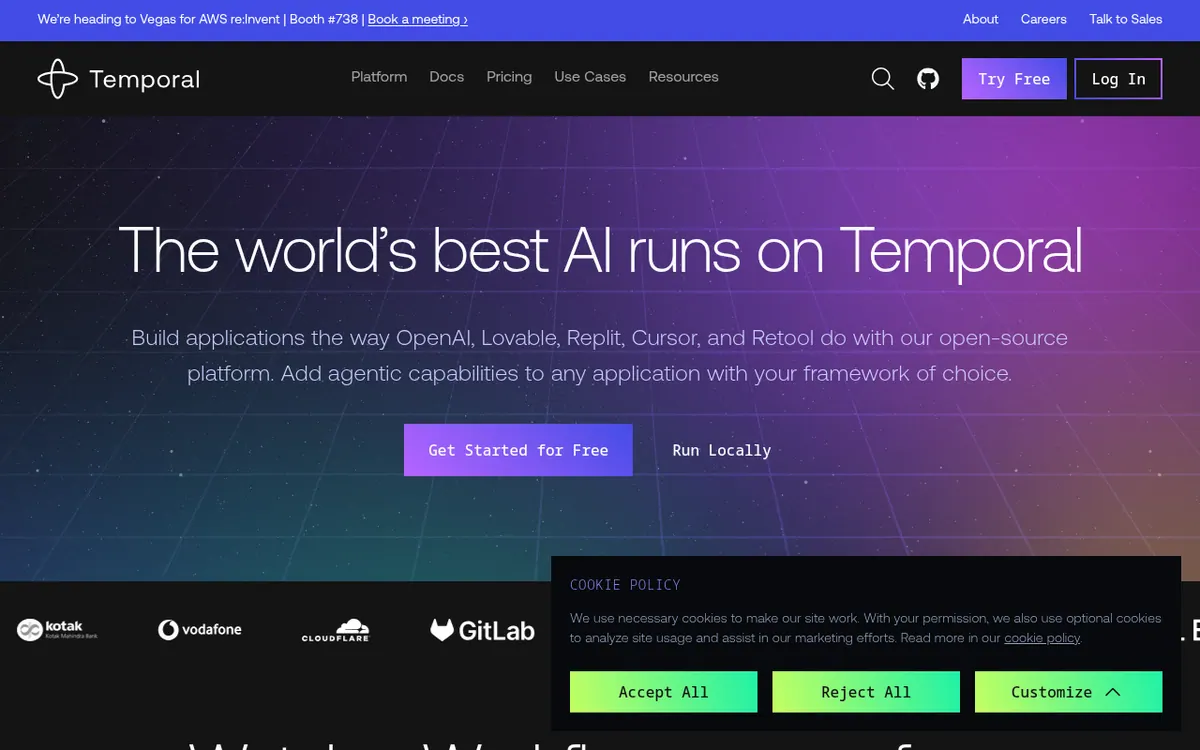
What Temporal does
Runs your application logic as durable Workflows that save state and retry failing steps, so processes continue after crashes or outages.
Temporal is a platform for running application logic so that it survives crashes, network faults and failing services. Developers write business logic as code in a Workflow, and the platform records state at each step so a run can continue from where it stopped. Calls to unreliable systems are written as Activities, which can be retried automatically under a policy you set.
The project is open source, so you can host the Temporal Service yourself, or you can use the managed Temporal Cloud. Application code, such as Workflows and Activities, runs on your own infrastructure through language SDKs. The official pages list Go, Java, Python, TypeScript, .NET, PHP, Ruby and Rust. A command-line tool for macOS, Windows and Linux starts a local development server, and a browser-based Web UI lets you inspect running and past executions.
Features named on the site include durable timers, cron-style schedules, signals, queries, updates, child Workflows and task queue priority. Typical uses listed include AI agents, human-in-the-loop steps, saga-style compensation, long-running Workflows, order fulfillment and CI/CD.
Temporal Cloud is priced by usage. The Pay-As-You-Go plan starts at $50 per million actions with no base monthly fee, plus separate charges for active and retained storage. New accounts get $150 in credits for 90 days. Optional support add-ons are sold separately, and larger volumes can get discounts through a commitment.
- Durable Workflows that resume after failure
- Activities with automatic retries
- Durable timers and cron-style schedules
- Signals, Queries and Updates for live Workflows
- Multi-language SDKs
- Self-hosted or Temporal Cloud
- Web UI for execution visibility
- Local dev server via command line
Good for / Not for
Good for
- Developers building long-running or multi-step processes like orders, payments or deployments
- Teams building AI agents or pipelines that must survive failures
- Teams that want to self-host an open-source service or use a managed cloud
Not for
- People wanting a no-code tool, since logic is written with an SDK
- Buyers needing a fixed monthly price, as Temporal Cloud is billed per action and storage
How to start
Sign up for Temporal Cloud to receive $150 in free credits. source
Or start a local dev server from the command line with: brew install temporal && temporal server start-dev. source
Write your business logic as Workflows and Activities with the SDK for your language, then deploy it on your own infrastructure. source
Connect the application to a Temporal Service, either self-hosted or Temporal Cloud, and watch executions in the Web UI. source
Limits and gotchas
- The free credits are valid for 90 days. source
- On top of actions, storage is charged separately, with active storage at $0.042/GBhr and retained storage at $0.00105 as the starting rates. source
- Developer support is priced at 10% of usage, while Business support costs whichever is higher: $500/mo or 10% of usage. source
- SCIM is offered as an add-on, and the pricing page says add-on capabilities can carry extra charges. source
From the official site and docs of Temporal, checked on October 30, 2026.
Pros and cons
Pros
- Open source, so the service can be self-hosted in your own environment
- Managed Temporal Cloud has no base monthly fee and starts at $50 per million actions
- $150 in free credits for 90 days to try the cloud service
- SDKs for Go, Java, Python, TypeScript, .NET, PHP, Ruby and Rust
- Web UI and command-line tool for inspecting executions and running a local dev server
Cons
- Requires writing code with an SDK; it is not a no-code tool
- Cloud cost is usage-based, so the monthly total depends on actions and storage
- No permanent free cloud plan is stated; only trial credits for 90 days
- Support is an add-on: developer support is 10% of usage and Business support starts at $500/month
- SCIM is listed as an add-on
Our take
Temporal suits engineering teams building multi-step or long-running processes, such as payments, orders, deployments or AI agent pipelines, who want retries and state handled by a platform instead of custom code. The open-source route gives control, while Temporal Cloud removes the need to run the service. It is less suited to people wanting a no-code tool, since everything is defined in code through an SDK. Cloud costs depend on actions and storage, so budgeting needs an estimate of usage. Support is a separate add-on, and the pricing page does not show a permanent free tier beyond the trial credits.
Comparisons and lists with Temporal
Coming soon
Coming soon — we are writing comparisons that include Temporal.
Temporal pricing
| Plan | Monthly billing | Annual billing (per month) | Limits / what’s included |
|---|---|---|---|
| Pay-As-You-Go starting at, per million actions (usage-based, no base month | — | — | No base monthly fee; storage billed separately; self-service volume pricing down to $25 per million actions; $150 free credits for 90 days |
Free trial: $150 free credits for 90 days. Free plan: no.
Prices checked on on the official Temporal pricing page. “—” = not published.
Frequently asked questions
How is Temporal Cloud priced?
The Pay-As-You-Go plan starts at $50 per million actions with no base monthly fee. Active storage starts at $0.042/GBhr and retained storage at $0.00105/GBhr. Self-service volume pricing goes down to $25 per million actions.
Is there a free trial?
Yes. Signing up for Temporal Cloud gives $150 in free credits for 90 days.
Can I run Temporal myself?
Yes. Temporal is an open-source project that you are free to host in your own environment, or you can use Temporal Cloud.
Which programming languages are supported?
The pricing page lists SDKs for Go, Java, Python, TypeScript, .NET, PHP, Ruby and Rust.
What uptime does Temporal Cloud offer?
The pricing page states a 99.9% SLA, with 99.99% available through HA options.
Recently verified in Automation & AI Agents
 Forethought Verified Nov 2, 2026
 Hippocratic AI Verified Nov 2, 2026
 Inngest Verified Nov 2, 2026
 Kolo AI Verified Nov 2, 2026
 Mercury Verified Nov 2, 2026
 MindStudio Verified Nov 2, 2026
Add an AGIPicks badge to your site
The badge shows Temporal’s verification status on AGIPicks and links to this page. Light/dark and compact versions: badges.

Suggest an update
Wrong price, outdated fact or a tool that shut down? Are you the vendor and disagree with this page? Tell us, ideally with a link to the official page. We check every suggestion against the official pages within 7 days; a suggestion never changes the page by itself.