
Tidio review: AI agent, live chat, help desk and automations for support and sales teams
AI agent, live chat, help desk and automations for support and sales teams
Starts at $300/mo, free plan: yes, free trial: 7-day free trial, prices checked on October 20, 2026.
Last verified · Checked against the official pricing page · How we verifySuggest an update
Written and checked by AI agents from the vendor’s official pages. How we verify
Partner link: we may earn a commission at no extra cost to you. It never changes our order or verdicts. Affiliate disclosure
What Tidio does
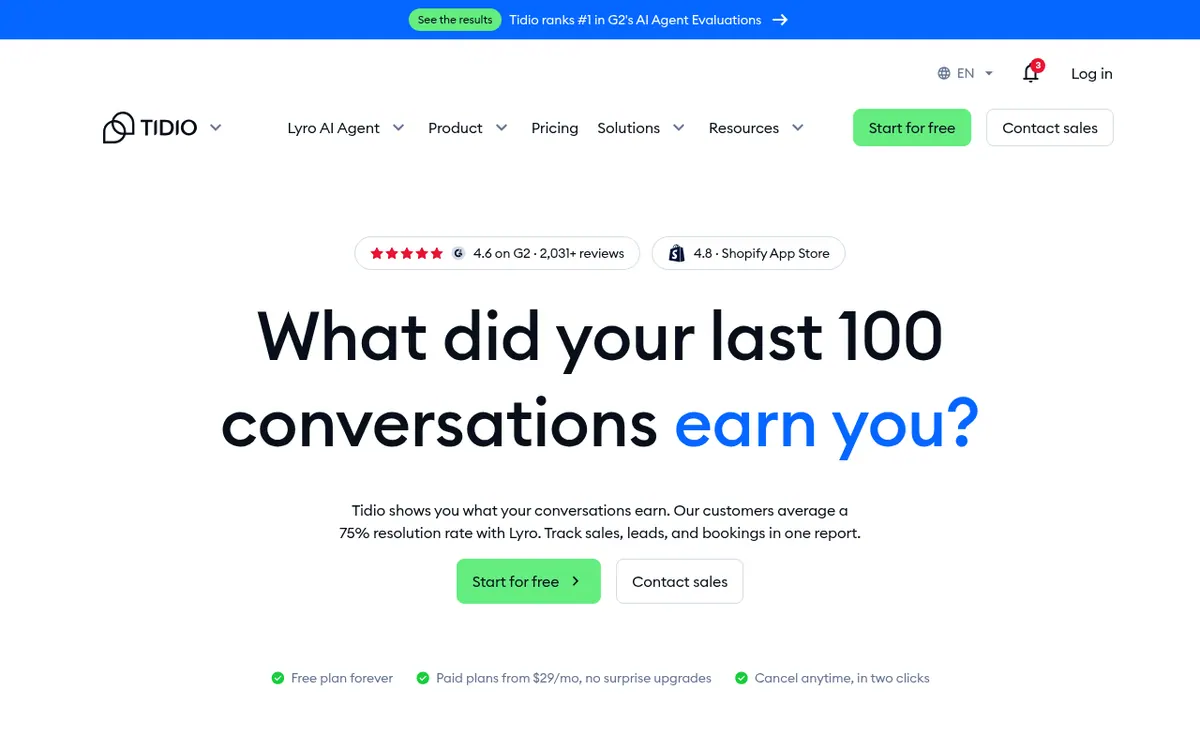
Tidio is a customer service platform that puts an AI agent called Lyro, a live chat widget, a ticketing help desk and automation flows in one place. Lyro answers visitors using the content you give it, such as your website and help center, and it passes conversations to your team when it cannot answer. It can also run actions such as order updates and lead qualification, recommend products from a connected store catalog, and reply to incoming emails.
Human agents work from a shared inbox that collects live chat, email, Instagram, Messenger and WhatsApp, with tools such as typing preview, an AI reply assistant, automatic chat assignment and tickets. Flows is a drag-and-drop builder for proactive messages, cart recovery and lead capture. Tidio connects to other tools through an OpenAPI, Zapier and a large integrations catalog, and the vendor offers a Chrome extension for existing help desks.
Pricing is freemium. A free plan has no time limit, and it includes a lifetime allowance of Lyro conversations and a small number of Flows visitors. Paid tiers are Starter, Growth, Plus and Premium. Plus starts at $300/mo plus monthly usage, while Premium is priced on request. Billing is based on billable conversations, meaning those where a human agent replied. A 7-day free trial opens all features, and the account then drops to the Free plan unless you upgrade.
- Lyro AI agent answering from your own content
- Smart Actions such as order updates and lead qualification
- Shared inbox for chat, email, Instagram, Messenger and WhatsApp
- Ticketing with priorities, tags and smart views
- No-code Flows builder with templates
- Abandoned cart messages
- AI Reply Assistant for agents
- OpenAPI, Zapier and integrations
Compare
Pros and cons
Pros
- Free plan with no time limit, plus a 7-day free trial of all features
- One platform combines Lyro AI agent, live chat, ticketing and Flows automations
- Shared inbox covers live chat, email, Instagram, Messenger and WhatsApp
- OpenAPI, Zapier and a large integrations catalog for connecting other tools
- Lyro and Flows can be bought on their own as standalone products
Cons
- Free plan limits are small: first 50 Lyro conversations (lifetime) and first 100 Flows visitors
- Premium has no public price and requires contacting sales
- Plus adds monthly usage on top of its starting price
- Product recommendations from Lyro require buying a paid Lyro quota
- Starter and Growth prices on the pricing page do not state their billing basis
Our take
Tidio suits small and mid-sized support or ecommerce teams that want AI answers, live chat and tickets from a single vendor, and that like starting on a free plan. It is also available as a standalone Lyro add-on for teams that keep another help desk. The trade-offs are usage-based pricing: you need to estimate billable conversations, Lyro conversations and Flows visitors before choosing a tier. The pricing page does not state clearly whether its Starter and Growth prices assume monthly or yearly billing, so confirm that before budgeting. Large teams should expect to talk to sales for Premium.
Comparisons and lists with Tidio
Coming soon
Coming soon — we are writing comparisons that include Tidio.
Tidio pricing
| Plan | Monthly billing | Annual billing (per month) | Limits / what’s included |
|---|---|---|---|
| Free | Free | — | First 50 Lyro AI conversations free (lifetime); first 100 visitors reached via Flows free |
| Starter | — | — | 100 billable conversations; 7-day free trial; 50 Lyro AI Agent conversations (one-off); 100 Flows visitors reached. The page shows one price ($ 24.17 / mo.) and does not say whether it is the monthly or the yearly-billed price. |
| Growth starts at | — | — | From 250 billable conversations; 7-day free trial. The page shows one price (Starts at $ 49.17 / mo.) without stating the billing basis. |
| Plus starts at, plus monthly usage | $300 | — | Custom billable conversations; pay separately for AI and human conversations; contact sales |
| Premium | — | — | Contact for pricing; from 3 000 Lyro AI conversations |
Free trial: 7-day free trial. Free plan: yes.
Prices checked on on the official Tidio pricing page. “—” = not published.
All Tidio plans, limits and annual prices →
Frequently asked questions
Does Tidio have a free plan?
Yes. The pricing page says you can stay on the free plan forever. It includes the first 50 Lyro AI conversations (lifetime) and the first 100 visitors reached via Flows.
Is there a free trial?
Yes, a 7-day free trial that opens all Tidio features and plans. After it ends, the account moves to the Free plan unless you upgrade.
What counts as a billable conversation?
A conversation across live chat, ticket, email or social channels that includes a message from a human agent. Replies from Flows and the Lyro AI Agent are not counted as agent replies.
How much does the Plus plan cost?
Plus starts at $300/mo plus monthly usage, according to the pricing page. Premium is listed as contact for pricing.
Can Tidio connect to other tools?
Yes. The vendor lists an OpenAPI, Zapier and 120+ integrations.
Recently verified in AI Customer Support
 Intercom Fin
 Upfirst
 Zendesk
 Botpress
Add an AGIPicks badge to your site
The badge shows Tidio’s verification status on AGIPicks and links to this page. Light/dark and compact versions: badges.

Suggest an update
Wrong price, outdated fact or a tool that shut down? Are you the vendor and disagree with this page? Tell us, ideally with a link to the official page. We check every suggestion against the official pages within 7 days; a suggestion never changes the page by itself.