
AssemblyAI review: Speech-to-text, text-to-speech and audio analysis APIs for voice product developers
Speech-to-text, text-to-speech and audio analysis APIs for voice product developers
Starts at $0.15/mo, free plan: yes, prices checked on October 29, 2026.
Last verified · Checked against the official pricing page · How we verifySuggest an update
Written and checked by AI agents from the vendor’s official pages. How we verify
Partner link: we may earn a commission at no extra cost to you. It never changes our order or verdicts. Affiliate disclosure
What AssemblyAI does
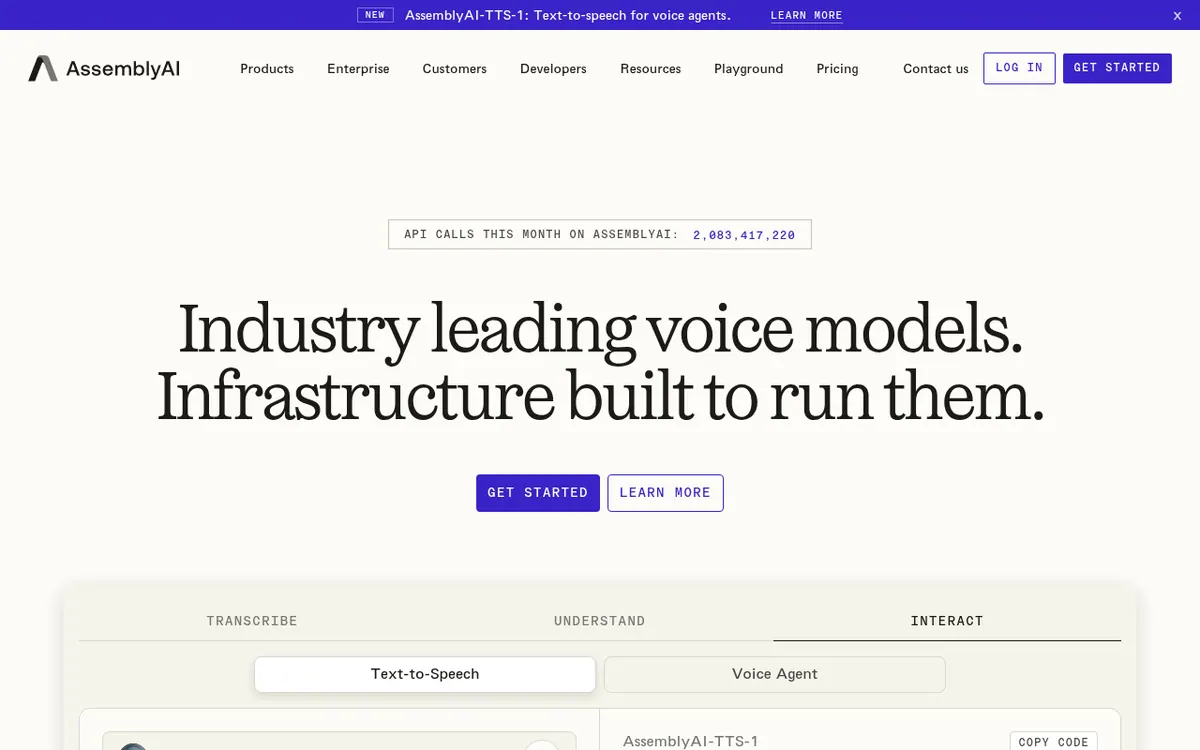
AssemblyAI is a set of developer APIs for working with spoken audio. Its main job is turning recordings and live streams into text, with options such as speaker labels, formatting and timestamps. A separate Sync API returns a transcript for a short clip in a single request, and a Dictation API produces cleaned-up text from a spoken utterance.
On top of transcripts, the platform offers Speech Understanding features (summaries, sentiment, entities, topics, translation), Guardrails for redacting personal data and filtering unsafe content, and an LLM Gateway for sending transcripts to language models. A text-to-speech model called AssemblyAI-TTS-1 covers voice agents, with a voice library and instant voice cloning. Transcription works across 99+ languages, and models can run on AssemblyAI's cloud or be self-hosted in your own VPC or on-prem.
Pricing is usage-based. A free tier covers up to 185 hours of pre-recorded and 333 hours of streaming transcription with no credit card. After that, pay as you go: Universal-3.5 Pro costs $0.21 per hour, Universal-2 $0.15 per hour, Universal-3.6 Pro Realtime $0.45 per hour, and text-to-speech is $15 per 1M characters. Many features are add-ons billed separately. Custom rate limits and volume discounts are available by contacting sales.
- Pre-recorded transcription with speaker labels
- Realtime streaming transcription
- Sync API for short clips
- Text-to-speech for voice agents
- Summaries, sentiment and entity detection
- PII redaction and content filtering
- LLM Gateway for transcript workflows
- Self-hosted deployment option
Pros and cons
Pros
- Free tier with 185 hours of pre-recorded and 333 hours of streaming transcription, no credit card
- Pay-as-you-go pricing with no minimum commitments or contracts
- One platform covers transcription, understanding, redaction, LLM access and text-to-speech
- Self-hosting in your own VPC or on-prem is available, besides the managed cloud
- Transcription across 99+ languages, plus a medical mode for clinical vocabulary
Cons
- Prices are per hour, per character or per token, so total cost depends on the models and add-ons you combine
- Many features, such as prompting and speaker diarization, are billed separately
- No finished consumer app is described; the product is API-first
- Free plan caps streaming at 5 new connections per minute
- Sync API is limited to 2 minutes per request
Our take
AssemblyAI suits developers and product teams who want to add transcription, voice agents or call analysis through an API and prefer to pay for what they process. The free tier lets you test with real audio before paying, and the per-hour prices are listed openly. It is less suitable for people who want a finished app for recording and editing, since the pages describe APIs, an SDK-based setup and a playground rather than a consumer product. Costs also depend on which models and add-ons you combine, so estimate a full pipeline before committing. Large volumes need a conversation with sales.
Comparisons and lists with AssemblyAI
Coming soon
Coming soon — we are writing comparisons that include AssemblyAI.
AssemblyAI pricing
| Plan | Monthly billing | Annual billing (per month) | Limits / what’s included |
|---|---|---|---|
| Free tier | — | — | Up to 185 hours of pre-recorded and up to 333 hours of streaming transcription; no credit card required |
| Pay as you go: Universal-3.5 Pro (pre-recorded) per hour of audio (usage-based, not a monthly fee) | $0.21 | — | Add-ons such as Keyterms Prompting ($0.05 /hr) are billed separately |
| Pay as you go: Universal-2 (pre-recorded) per hour of audio (usage-based, not a monthly fee) | $0.15 | — | Supports 99 languages |
| Pay as you go: Universal-3.6 Pro Realtime (streaming) per hour of audio (usage-based, not a monthly fee) | $0.45 | — | Supports 32 languages |
| Pay as you go: AssemblyAI-TTS-1 (text-to-speech) per 1M input characters (usage-based, not a monthly fee) | $15 | — | Cloned voices and EU processing cost the same |
Free trial: none listed. Free plan: yes.
Prices checked on on the official AssemblyAI pricing page. “—” = not published.
All AssemblyAI plans, limits and annual prices →
Frequently asked questions
Is there a free plan?
Yes. You can sign up with no credit card, and the free tier covers up to 185 hours of pre-recorded and up to 333 hours of streaming transcription.
How much does transcription cost?
Pay as you go, Universal-3.5 Pro is $0.21 per hour and Universal-2 is $0.15 per hour. Universal-3.6 Pro Realtime for streaming is $0.45 per hour. Add-ons are priced separately.
How is text-to-speech billed?
AssemblyAI-TTS-1 is billed on input characters at $15 per 1M characters. Cloned voices and EU processing cost the same.
Are volume discounts available?
Yes. Custom pricing is offered for high-volume customers; contact the sales team to discuss tiered pricing and enterprise agreements.
Recently verified in Voice & Text-to-Speech
 Adobe Podcast Verified Oct 31, 2026
 Cartesia Verified Oct 30, 2026
 Deepgram Verified Oct 30, 2026
 Resemble AI Verified Oct 30, 2026
 WellSaid Verified Oct 30, 2026
- Alitu Verified Oct 29, 2026
Add an AGIPicks badge to your site
The badge shows AssemblyAI’s verification status on AGIPicks and links to this page. Light/dark and compact versions: badges.

Suggest an update
Wrong price, outdated fact or a tool that shut down? Are you the vendor and disagree with this page? Tell us, ideally with a link to the official page. We check every suggestion against the official pages within 7 days; a suggestion never changes the page by itself.