A short list of proxy networks and scraping APIs with their rotation options, anti-bot handling, free entry points and starting prices, plus a step-by-step setup of a rotating residential proxy.
Scrapers get blocked when too many requests come from one IP address, so most scraping projects route traffic through a pool of proxies. There are two ways to buy that. A proxy network sells you access to residential or datacenter IPs, usually billed per GB of traffic, and your own code handles retries, rendering and CAPTCHAs. A scraping API bills per successful request and bundles the proxy, rotation and anti-bot handling into one call. The right choice depends on how much of the stack you want to own, how protected your target sites are, and whether your costs grow with bandwidth or with page count. This page compares five catalog tools on those points: product type, pool size, rotation and sticky sessions, anti-bot handling, free entry options and the published starting price. Every value comes from the vendor's own pricing page or documentation, checked on 2026-10-20. The steps section shows how to set up a rotating residential proxy on one of them.
Bright Data sells both a residential network and an unblocking API and lists unlimited seats; ZenRows has a no-card free plan; Decodo sells residential traffic pay-as-you-go at $4/GB.
Offers a residential network the vendor puts at 400M+ IPs in 195 countries with sticky and rotating sessions, plus Web Unlocker, which handles CAPTCHA solving and retries for you.
When to pick it: If you want one vendor for raw proxies and a managed unblocking API, and can pass a KYC check for residential IPs.
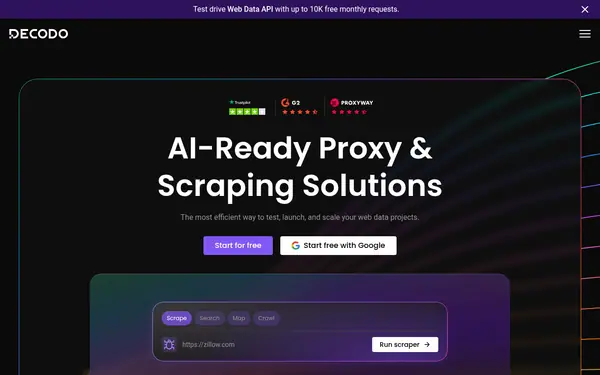
Residential proxies billed per GB with per-request rotation or one IP kept for up to 30 minutes, targeting down to ZIP code and ASN, and a 3-day trial with 100 MB.
When to pick it: If you run your own scraper and want per-GB billing without a long commitment, starting from pay-as-you-go.
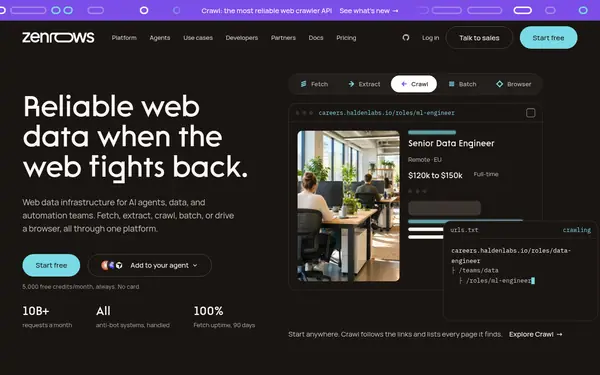
Scraping API where one parameter switches a request to residential IPs together with anti-bot handling; failed requests are not charged and a free plan gives 5,000 credits a month.
When to pick it: If you prefer paying per successful page and want rendering and anti-bot handling bundled with the proxy.
Scraping API with rotating proxy pools, CAPTCHA and anti-bot handling on all plans, and a proxy-port mode so existing scrapers can use it like a normal proxy.
When to pick it: If your scraper already expects a proxy address and you want the vendor to manage rotation and retries.
Choose a monthly subscription, or the 3-day free trial with 100 MB if you are a new user. For a one-off job, top up the Wallet and buy traffic with Pay As You Go at $4 per GB, one GB at a time. A subscription and Pay As You Go cannot run at the same time.
Leave the location random or target a country, city or US state. Then choose whether the IP rotates on every request or stays the same for up to 30 minutes.
Bright Data asks for a short KYC compliance check, which may include a video call, before you can use its residential or mobile IPs. Web Unlocker does not require KYC. source
Decodo's 14-day refund applies only to a first purchase, not after the 3-day trial, and only if no more than 20% of a regular plan's traffic was used. source
ScraperAPI charges more credits for harder sites: Amazon 5, Google and Bing 25, LinkedIn 30, and sites behind Cloudflare, Datadome or PerimeterX add 10 per request. Unused credits do not roll over. source
ZenRows' free plan excludes standalone Residential Proxies, and on paid plans residential bandwidth draws 25,000 credits per GB. source
WebScrapingAPI documents a maximum sticky window of 10 minutes, so long logged-in sessions need another option. source
Frequently asked questions
Is there a free proxy for web scraping?
ZenRows has a free plan with 5,000 credits per month and no card. It unlocks every feature except standalone Residential Proxies, it allows 5 concurrent requests, and unused credits do not roll over.
What is a rotating proxy?
A rotating proxy gives a request a different IP address from the pool, often on every request. WebScrapingAPI rotates by default. If you add a session ID and a rotation value, it keeps the same residential IP for 3, 5 or 10 minutes.
Should I buy residential proxies or use a scraping API with residential IPs?
ZenRows explains the difference on its own products. Standalone residential proxies give you only the IP pool, and your code handles rendering and CAPTCHAs. Its Fetch API with premium_proxy=true uses the same residential IPs plus built-in anti-bot handling in one call.
How does proxy rotation work for web scraping?
With Decodo residential proxies you choose the session type in the dashboard. The IP either rotates on every request or stays the same for up to 30 minutes. Location can be random or set to a country, city or US state.
How do web scraping proxy services charge?
Proxy networks usually bill per GB of traffic. Scraping APIs bill per request. In ScraperAPI's case a standard page costs 1 credit, Amazon 5, Google and Bing 25 and LinkedIn 30. The dashboard has a Domain Cost Estimator, and you can set a max_cost limit per request.
Can a scraping API be used as a normal proxy server?
Yes, for ScraperAPI. Besides its API endpoints, it accepts requests through a proxy port (proxy-server.scraperapi.com:8001) with your API key as the password. The vendor recommends setting a 70-second timeout in your application.
Something wrong or missing on this page — a wrong fact, an outdated price, a tool that should be here? Tell us, ideally with a link to the official page. We check every suggestion within 7 days; a suggestion never changes the page by itself.